Mini golf payment processing fees in 2026 explained: Stripe-specific costs, effective rates, hidden charges, and how to save thousands with the right POS and QR-based pay system.
The real cost of payment processing for mini golf courses in 2026 is not just the flat rate you see on Stripe's website. Most courses pay between 2.5% and 3.5% plus $0.10 to $0.30 per transaction, and when you layer in ticket fees, keyed-in surcharges, chargebacks, and POS hardware costs, the effective rate often climbs above 4%. For a course doing $400,000 in summer revenue, that difference amounts to thousands of dollars per year. The good news: the right mini golf software stacks, like Mini Golf OS Tool (Powered by Birdie & Bytes), can help you compare processors, negotiate better rates, automate payments, and keep the total cost of accepting cards under 2.9% effective.
Why Payment Processing Costs Are Higher Than You Think in Mini Golf
Transaction fees are based on percentage plus a fixed fee. That fixed fee is disproportionately heavy on small average tickets. A typical mini golf ticket might be $15 for a child and $18 for a single adult. A family group could pay $60 for a round of four. Unlike restaurants with larger checks, mini golf’s per-transaction economics quickly erode 5% to 7% of your revenue when a $12 single-play ticket gets a 2.9% + $0.30 swipe.
Types of Credit Card Fees on Mini Golf Transactions
- Interchange fee: Paid to the issuing bank. Ranges from 1.5% to 2.5% for consumer credit cards and 0.8% to 1.5% for debit cards.
- Processor markup: The payment processor’s cut (e.g., Stripe adds ~0.4% to 0.9% depending on plan/volume).
- Card network fee: Visa, Mastercard, Discover, and Amex charge their own assessments, usually 0.13% to 0.23%.
- Fixed transaction fee: A per-transaction cost from $0.05 to $0.30 that hits every sale, large or small.
- Keyed-in / manually entered surcharge: Many processors add 0.5% to 1% extra for card-not-present or typed card-entry transactions.
- Chargeback fees: Typically $15 to $25 per dispute, even if you win.
So when someone says “Stripe is just 2.9% + 30 cents,” that number only covers card-present transactions with standard consumer cards. Add a keyed-in entry for phone reservations, Amex, or international cards, and the rate jumps to 4.4% or more.
Stripe Fees for Mini Golf Courses in 2026: A Direct Breakdown
Stripe remains one of the most popular payment gateways in 2026, especially for online mini golf booking systems. Stripe’s default fees are:
- Online and in-person card transactions: 2.9% + $0.30 per successful charge.
- Manually keyed card entry (e.g., phone booking): 3.4% + $0.30.
- International cards: additional 1% + currency conversion fee.
- ACH / bank debit payments: 0.8% capped at $5 (often not suitable for POS).
- Instant payouts to your bank account: 1% of balance transferred.
Yet most mini golf owners overlook other costs inside Stripe. When your guests pay with a tap-to-pay vs. manually keyed entry, the fee difference can be substantial. If your POS doesn't support text-to-pay links or your online checkout redirects the customer back too early, you could accidentally trigger card-not-present fees. Mini Golf OS Tool uses Stripe’s latest payment APIs and automatically optimizes each transaction for card-present or low-risk tokenized payments, lowering the effective rate closer to 2.5%–2.7%.
Comparing Payment Processors for Mini Golf: Real Pricing Table
The table below illustrates 2026 standard rates for common payment processors but also shows the effective cost for a typical $45 mini golf family transaction. In practice, your actual rate depends on volume, average ticket, card mix, and how the payment is taken.
| Processor | Pricing Model | Base Rate | Effective Rate on $45 Ticket | Key Notes for Mini Golf |
|---|---|---|---|---|
| Stripe | Flat rate | 2.9% + $0.30 | 3.57% | Best for online & modern integration, keyed-in entries cost more. |
| Square | Flat rate | 2.6% + $0.10 (in-person) | 2.82% | Hardware discount but limited booking/CRM integration without add-ons. |
| Toast (if available for entertainment venues) | Interchange-plus | Interchange + 0.5% + $0.20 | ~2.85% | Good for high volume, but contracts often require proprietary equipment. |
| Traditional merchant account (e.g., Elavon, Fiserv) | Interchange-plus | Interchange + 0.4% + $0.10 | ~2.6% (negotiated) | Can be cheaper but often lacks modern mini golf-specific reservations. |
| Mini Golf OS Tool (Powered by Birdie & Bytes) with Stripe | Optimized flat | Stripe’s fee + built-in fee comp analyzer | As low as 2.5% – 2.9% | Combines course management and payment infrastructure with cost transparency. |
Hidden Payment Costs That Never Appear on Your Terminal
Payment processing doesn’t stop at the acquiring banks. Mini golf courses carry unique overhead:
POS and Booking Software Fees
You already pay for your point-of-sale, tee time scheduler, birthday party manager, and online booking system. If those are disconnected from your payment processor, you’ll pay expensive bridge integrations and lose revenue from abandoned bookings. Mini Golf OS Tool serves as the single management and scheduling platform, so you don’t double-pay for separate systems.
Chargeback Prevention Costs
Rain checks, group cancellations, and unhappy customers can trigger disputes. A single chargeback costs $15 to $25 and steals time from your staff. Mini Golf OS Tool automatically sends confirmation texts, records signed digital waivers, and inserts transaction line items — all of which lower the probability of a ‘did not recognize the charge’ dispute.
Hardware and Terminal Depreciation
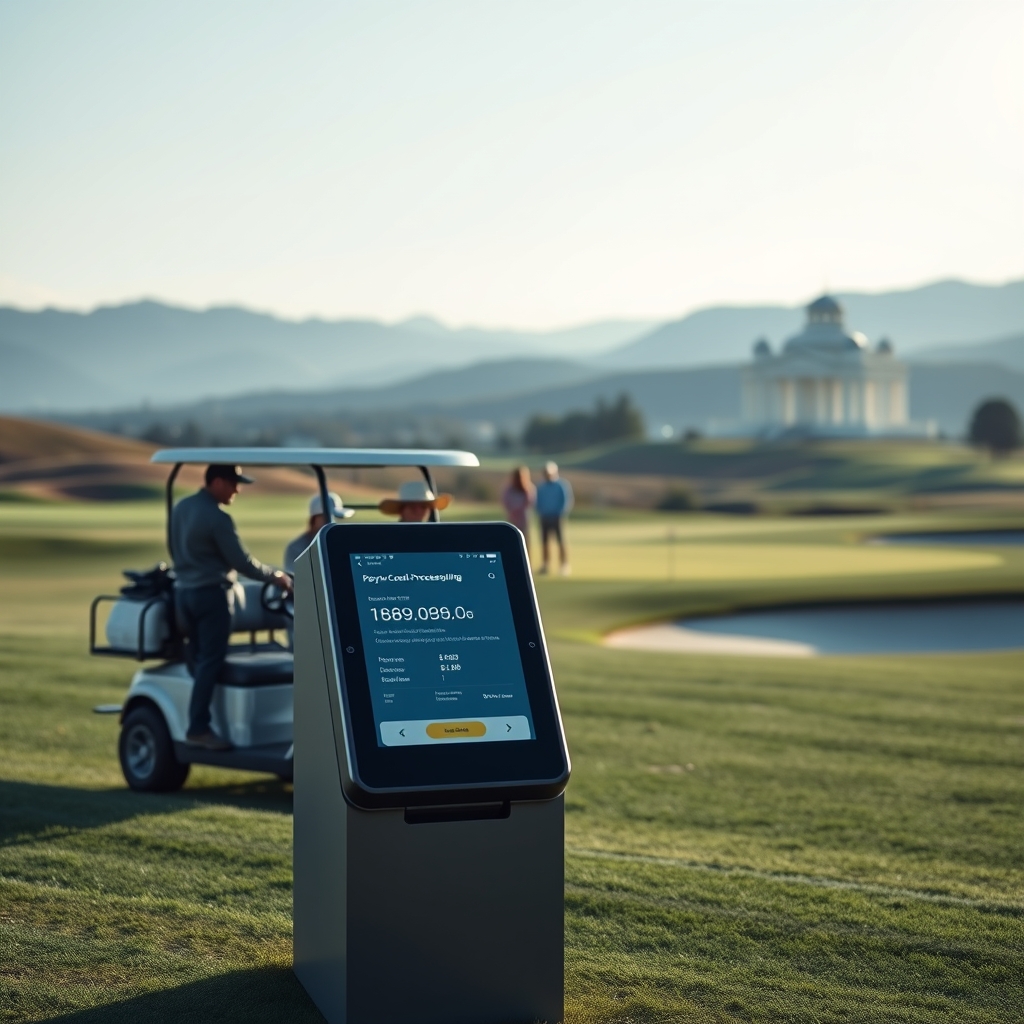
Traditional POS terminals break, need replacing every 3–5 years, and sometimes require proprietary software upgrades. In 2026, most mini golf course owners are moving to a countertop tablet with a QR code mobile checkout. Stripe’s mobile reader costs around $59, but using only your phone with a Mini Golf OS Tool QR link means $0 hardware cost. Your staff stays flexible to manage the course while players checkout safely.
How Mini Golf OS Tool Cuts Real Payment Processing Costs
Mini Golf OS Tool (Powered by Birdie & Bytes) is built to reduce the total cost of payment and course operations:
- Automated scheduling and bookings: Guests prepay or book online, avoiding keyed-in fees at the counter. Stripe takes a lower fee for online card-not-present? Actually Stripe's online rate is still 2.9% + $0.30, but by enabling reusable saved cards and automated receipts, you reduce manual keyed entry of 3.4% + $0.30.
- Integrated QR on the stick or scorecard: A customer can tap at the course, pay on their phone, and walk away. That’s the lowest-risk, lowest-card-present fee tier that Stripe offers.
- Revenue management dashboard: See real-time payment processing fees, coupon impact, and net revenue per hour, not just gross sales.
- Simplified chargeback evidence: The platform logs each transaction with the exact product (9-hole, 18-hole, rental club, birthday party deposit). If a customer files a “not recognized” dispute, the central dashboard gives you one-click proof.
- No per-terminal seating fees and no separate booking portal: You pay for your software, not for 3 different SaaS tools that each mark up payment costs.
Can You Negotiate Stripe Fees or Lower Interchange for Mini Golf?
Yes, in two ways. First, choose Interchange-plus pricing. Stripe’s default is flat-rate; if you process more than $100k/month, contact Stripe or switch to an ISO that offers interchange-plus with transparent pass-through costs. Second, reduce interchange by always using chip or mobile wallet (tap) transactions, never keyed entry. Mini Golf OS Tool automates mobile links that allow staff to take tap-to-pay or send a payment link to the guest's phone without calling the processor manually.
You also want to encourage debit and prepaid cards, but that’s difficult in the physical store. Instead, consider offering a small discount for cash or QR digital payments. Since QR payments can route as debit via wallets on some setups, the net effective rate can be as low as 1.5% for digital wallet if your processor supports it. Mini Golf OS Tool’s scanner can help you test these card types and build reporting to show you your mix in real time.
Real-World Example: How a $450,000 Mini Golf Course Saves $8,000 per Year
Let’s say a mini golf course in Phoenix does $450,000 in annual card transactions. Average group ticket is $55. They process 8,182 transactions per year. At a simple Stripe flat rate of 2.9% + $0.30, they pay 2.9% = $13,050 + $2,455 in per-transaction fees, totaling $15,505. That’s 3.45% effective. If they use Mini Golf OS Tool’s built-in fee analyzer and update to automatic digital receipts and tap-to-pay at the order station, they reduce the effective rate to 2.6% + $0.18 per transaction (when negotiated or by using lower debits and no manual entries). They then pay $11,700 + $1,473 = $13,173. Saving: $2,332 per year. Add removed chargeback fees (maybe $300) and saved labor on manual recaps ($2,000), it gets closer to $5k–$8k.